
|
    Professional Email Marketing Solutions |
Marketing Research Chart: What information do marketers ask for on list registration forms?
Author: marketingsherpa
“Access to data for personalizing content.”
That was the response from one marketer when we asked what new developments will affect their email marketing programs over the coming year.
There are many ways to find data about potential customers. There’s transactional data. Behavioral data. Data appending.
Marketers may also simply ask them. One major way to collect this data is when prospective customers first register for your list. In the MarketingSherpa 2013 Email Marketing Benchmark Report, we asked marketers …
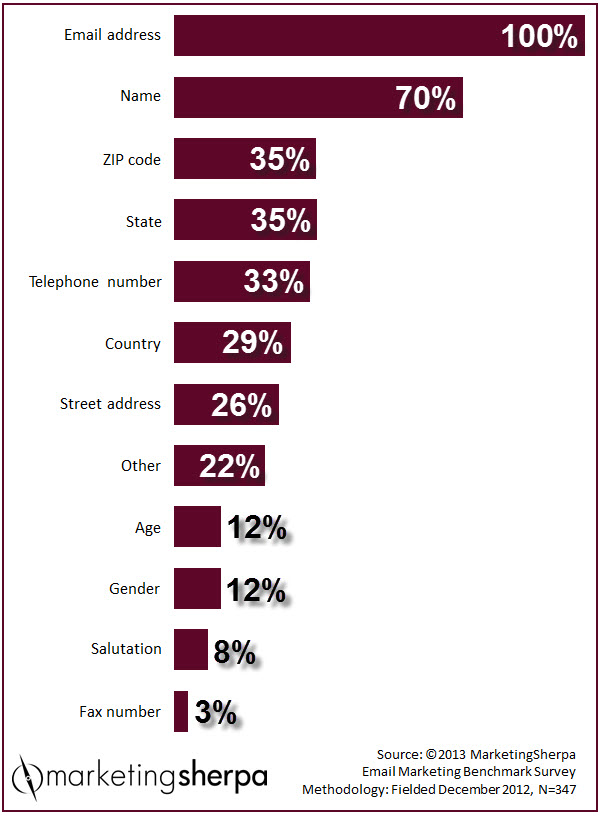
Q: Which form data do you collect in the registration process for your email program?
Click here to see a printable version of this chart
The basics
If you’ve been a reader of MarketingSherpa’s Chart of the Week for any length of time, you'll see how rarely, if ever, every marketer responding will report being engaged in a tactic. For example, in last week’s chart, we learned more than one-third of marketers surveyed do not engage in an elementary deliverability tactic — providing an easy unsubscribe process.
So, with tongue firmly planted in cheek, it’s nice to see all marketers agreeing on something — asking for an email address on an email registration form.
A steep drop-off
The drop-off is steep from there. The only other field requested by a majority of marketers is name.
Admittedly, some of these fields are mutually exclusive. For example, if you request ZIP code, you do not need to ask for state or country.
Some fields simply don’t apply to certain products. While a marketer that sells both male and female clothes may find the gender field essential, if you sell a B2B cloud computing solution, for example, gender is meaningless.
Nor am I necessarily suggesting you should be asking for more information on your email list registration forms. While the increased amount of data can help you personalize and segment your email sends to deliver more relevant content to your audience, the more info you ask for, the less list sign-ups you are likely to receive.
Not all information requests are created equally
Of course, it’s not only the number of fields you have in your registration forms, but the friction and anxiety associated with those forms.
For example, most customers are much less likely to want to share their telephone number early in the funnel (or will share the ever popular 999-999-9999) because, while they may be ready to receive emails from you, they may not be deep enough in the funnel to want a sales call.
When we break out the data, it is interesting to note that only 22% of B2C marketers, who usually have a simpler sales process, ask for telephone numbers while 37% of B2B and/or B2G marketers and 38% of those who market to both a B2B and B2C audience ask for telephone numbers.
This changes everything
Keep in mindwhen you decide how much information to ask for on your forms, the telephone changes everything.
In this sense, I’m not talking about a telephone number per se, but rather the smartphone computing platform, where simplicity is paramount.
As one survey respondent noted, “It will change the way we deliver content. Completing forms on smartphones is challenging and designing content for smart phone users means making engagement easier.”
Related Posts:

Leave a Reply

-ER, Association Marketing Director